Intravenous Conscious Sedation (aka “IV sedation”) is when a drug, usually of the anti-anxiety variety, is administered into the blood system during dental treatment. This type of sedation brings about an altered state of consciousness, known as a “twilight” state, which is an unsteady state of mind and a relaxed body. This mode of sedation reduces pain and discomfort with the use of pain relievers and sedatives. Patients who undergo treatments using conscious sedation generally are able to speak to verbal cues while the procedure is underway, conveying any discomfort being felt to the dentist. Once the procedure ends, a small period of amnesia could negate any recollection of the treatment.
Following your treatment(s), you will require a drive back to your home from the dental office. The sedative will wear off completely within 24 hours, so that you can resume day-to-day activities. You remain conscious during IV sedation. You will also be able to understand and respond to requests from your dentist. However, you may not remember much (or anything at all) about what went on because of two things:
The most commonly used drugs for IV sedation are benzodiazepines, or “benzos” for short. These are anti-anxiety sedative drugs. By far the most commonly used drug for IV sedation is Midazolam (Versed).
How is IV sedation given?
“Intravenous” means that the drug is put into a vein. An extremely thin needle is put into a vein close to the surface of the skin in either the arm or the back of your hand. This needle is wrapped up with a soft plastic tube. It makes the entry into the vein, then is slid out leaving the soft plastic tube in place. The drugs are put in through that tube which is correctly referred to as an “indwelling catheter”, The tube stays in place throughout the procedure. Throughout the procedure, your pulse and oxygen levels are measured using a “pulse oximeter”. This gadget clips onto a finger or an earlobe and measures pulse and oxygen saturation.
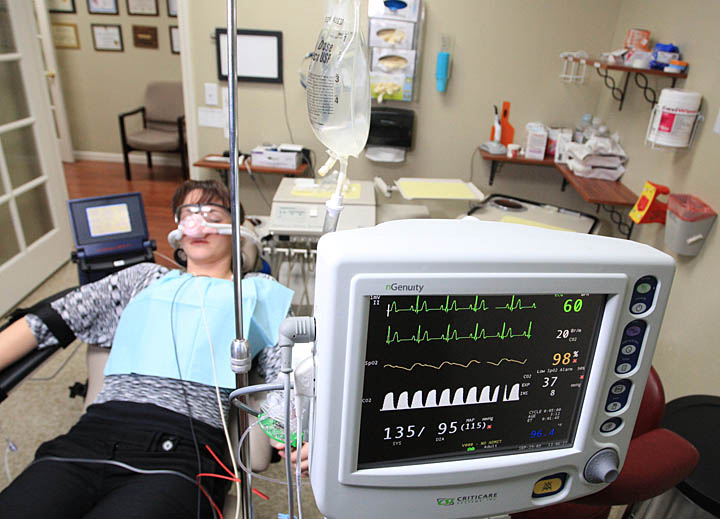
It gives a useful early warning sign if you’re getting too low on oxygen, although if your dentist and the nurses are paying attention they should see it way before the machine does grin. Blood pressure before and after the procedure should be checked with a blood pressure measuring machine.
Dr. Mehdi Noroozi is one of very few periodontists in Vancouver licensed by the College of Dental Surgeons of BC to provide intravenous sedation in order to give you peace of mind and make your experience much more pleasant with periodontal and implant procedures.
For more information, please contact us today.


Pinhole Surgical Technique, breakthrough gum grafting alternative treatment for gum recessions…

A minimally invasive solution with a fixed full-arch implant restoration for high patient satisfaction, Fixed (Non-removable) Same-Day-Teeth, providing immediate function and aesthetics

Unlike with regular scalpel “gum surgery” there is no cutting of the gum tissues or sewing with stitches, so the whole experience is virtually pain free. Laser
For nearly two decades, Dr. Noroozi and his dedicated team have transformed the smiles of thousands of patients, delivering exceptional results with minimal discomfort, fewer complications, and quicker recovery times. As the founder and clinical director of IMPrESS Perio Implant Center, Dr. Noroozi leads a renowned practice specializing in advanced microsurgery and minimally invasive periodontal and dental implant procedures.