A key to implant success is the quantity and quality of the bone where the implant is to be placed. The upper back jaw has traditionally been one of the most difficult areas to successfully place dental implants due to insufficient bone quantity and quality and the close proximity to the sinus. If you’ve lost bone in that area due to reasons such as periodontal disease or tooth loss, you may be left without enough bone to place implants.
Sinus lift surgery can help correct this problem by raising the sinus floor and developing bone for the placement of dental implants. Several techniques can be used to raise the sinus and allow for new bone to form.
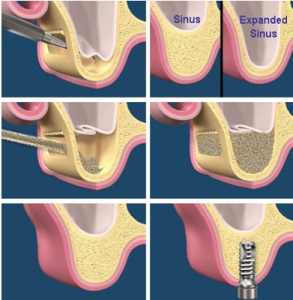
In one common technique, an incision is made to expose the bone. Then a small circle is cut into the bone. This bony piece is lifted into the sinus cavity, much like a trap door, and the space underneath is filled with bone graft material. Your periodontist can explain your options for graft materials, which can regenerate lost bone and tissue. Finally, the incision is closed and healing is allowed to take place. Depending on your individual needs, the bone usually will be allowed to develop for about four to 9 months before implants can be placed. After the implants are placed, an additional healing period is required. In some cases, the implant can be placed at the same time the sinus is augmented. Undergoing sinus lift surgery has been shown to greatly increase your chances for successful implants that can last for years to come. Many patients experience minimal discomfort during this procedure.
In the most common sinus augmentation technique, a tiny incision is made near the upper premolar or molar region to expose the jawbone. A small opening is cut into the bone and the membrane lining the sinus on the other side of the opening is gently pushed upward. The underlying space is filled with bone graft material and the incision is closed. The bone which is used for this procedure may be from your own body or from a cadaver. Sometimes the periodontist might use synthetic materials which can also stimulate bone formation. The implants are placed after healing has occurred; this will depend on the individual case. Sinus augmentation has been shown to increase the success of dental implant procedures.
Our Specialists in IMPrESS Perio Implant Center have undergone extensive training in sinus lift surgery and have developed tremendous experience and skills over years to safely perform the sinus lift surgery with predictable treatment outcome.
Dr. Noroozi utilizes the most advanced technologies such as Piezosurgery to make your sinus lift surgery safer, more effective and comfortable for you.
What Is It?
A sinus lift is surgery that adds bone to your upper jaw in the area of your molars and premolars. It’s sometimes called a sinus augmentation. The bone is added between your jaw and the maxillary sinuses, which are on either side of your nose. To make room for the bone, the sinus membrane has to be moved upward, or “lifted.” A sinus lift usually is done by a specialist.

What It’s Used For
A sinus lift is done when there is not enough bone height in the upper jaw, or the sinuses are too close to the jaw, for dental implants to be placed. There are several reasons for this:
Sinus lifts have become common during the last 15 years as more people get dental implants to replace missing teeth.
Preparation
The bone used in a sinus lift may come from your own body (autogenous bone), from a cadaver (allogeneic bone) or from cow bone (xenograft). You will need X-rays taken before your sinus lift so the dentist can study the anatomy of your jaw and sinus. You also may need a special type of computed tomography (CBCT) scan. This scan will allow the dentist to accurately measure the height and width of your existing bone and to evaluate the health of your sinus.
If you have seasonal allergies, you should schedule the procedure when they are not active.
How It’s Done
Your surgeon will cut the gum tissue where your back teeth used to be. The tissue is raised, exposing the bone. A small, oval window is opened in the bone. The membrane lining the sinus on the other side of the window separates your sinus from your jaw. This membrane is gently pushed up and away from your jaw.
Granules of bone-graft material are then packed into the space where the sinus was. The amount of bone used will vary, but usually several millimeters of bone is added above the jaw.
Once the bone is in place, the tissue is closed with stitches. Your implants will be placed four to nine months later. This allows time for the grafted material to mesh with your bone. The amount of time depends on the amount of bone needed.
Follow-Up
After the procedure, you may have some swelling of the area. You may bleed from your mouth or nose. Do not blow your nose or sneeze forcefully. Either one could cause the bone-graft material to move, and loosen the stitches.
Your dentist may give you saline sprays to keep the inner lining of your nose wet and prescribe medicine to prevent congestion and inflammation. You also will be given pain medicine, an antibiotic and an antimicrobial mouthwash to help prevent infection. Most patients have only a little discomfort after a sinus-lift procedure.
You will see the specialist after 7 to 10 days. He or she will evaluate the surgical site and remove stitches if they will not dissolve on their own. You might be asked to return a few more times to make sure the area is healing properly.
After a sinus lift, you need to wait several months for the bony material to harden and integrate with your jaw. Depending on the grafting material used, implants may be placed in four to nine months.
Our specialist is commonly using proteins called growth factors to help the new bone harden faster. Platelet-rich plasma, which contains the growth factors, is taken from your blood before surgery and mixed with the graft that is placed into your sinus. Human-recombinant bone morphogenetic protein is an engineered protein that is now available. It stimulates bone formation without grafting. The U.S. Food and Drug Administration has approved its use during a sinus lift procedure.
Risks
The main risk of a sinus lift is that the sinus membrane could be punctured or torn. If the membrane is torn during the procedure, the surgeon will either stitch the sinus tear or place a patch over it. If the repair is not successful, your surgeon may stop the procedure and give the hole time to heal.
Your dentist can redo the sinus lift once the membrane has healed. This usually takes a few months. A healed membrane tends to be thicker and stronger, which means a second attempt at a sinus lift is likely to be successful. However, other factors also affect success.
Infection is a risk of any surgical procedure. However, this rarely occurs after sinus lifts.
On rare occasions, the existing bone does not integrate with the bony graft material, and the grafted area does not develop a blood supply. If this happens, any implants placed in this area will fail because there is no live bone for them to attach to. If this happens, you can have the sinus lift procedure repeated.
When To Call a Professional
After a sinus lift, contact your surgeon if:

Pinhole Surgical Technique, breakthrough gum grafting alternative treatment for gum recessions…
A minimally invasive solution with a fixed full-arch implant restoration for high patient satisfaction, Fixed (Non-removable) Same-Day-Teeth, providing immediate function and aesthetics

Unlike with regular scalpel “gum surgery” there is no cutting of the gum tissues or sewing with stitches, so the whole experience is virtually pain free. Laser
For nearly two decades, Dr. Noroozi and his dedicated team have transformed the smiles of thousands of patients, delivering exceptional results with minimal discomfort, fewer complications, and quicker recovery times. As the founder and clinical director of IMPrESS Perio Implant Center, Dr. Noroozi leads a renowned practice specializing in advanced microsurgery and minimally invasive periodontal and dental implant procedures.